

Life science tools companies are sales-led organizations, where marketing is expected to hand over leads. However, marketing is much broader than that, and when viewed holistically, can strengthen alignment in commercial functions and lead to a clearer path to revenue generation. This article will cover the most common challenges in marketing life science tools that I have seen in my career, and include quotes from several experts who I interviewed for this piece.
Companies selling tools in the life science market, including reagents, instruments, software, kits, assays, AI tools for drug discovery, proprietary data models, or specialized services licensed to pharma companies or sold individually, depend on customer-facing employees to grow. In consumer goods, a marketing campaign can produce customers within hours. What works in B2B SaaS, where marketing thought leadership from marketing technology companies tends to filter via osmosis to industrial sectors, often falls completely flat in an industry with 6-12 month sales cycles like in life science.
Significantly larger deal sizes also make a purchasing decision more complex.
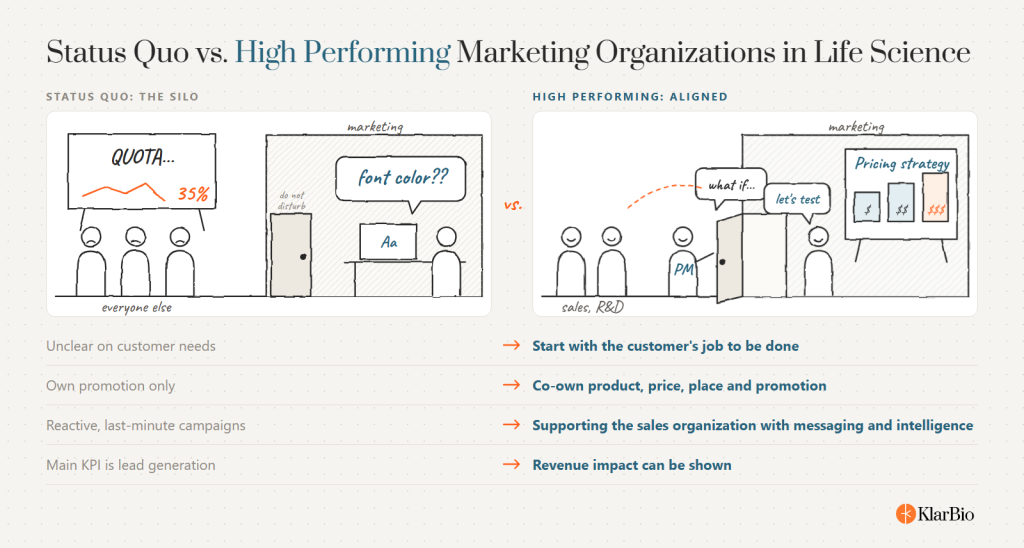
But what if I told you that marketing, as it is most often defined, is not just a case of promoting a product, but rather a process for how a product will capture value? Marketing involves 3 other P’s: product, place, and price, in addition to promotion. All of these create value together, no matter who is responsible for what.
The companies that succeed in life science tools, like Sartorius, Bio-Techne, Miltenyi Biotec, Zeiss, Illumina, Genovis, Cell Signaling Technologies, Twist Biosciences, Qiagen, and Thermo Fisher to name a few, demonstrate marketing maturity repeatedly.
Why Marketing Is Uniquely Challenging in the Life Sciences
The need for domain expertise is what makes marketing special in the life sciences. This applies to biological sciences, as well as computer science, as both fields are converging today. Those purchasing life science products have technical questions, so those responsible for communicating to the right stakeholders need to know the science.
This is why many sales people are application scientists, and many marketers tend to have a scientific background in this field. In fact, the field application scientist is what a marketer used to be traditionally: they learn about the customer’s needs and how their solution works for them. David Ogilvy described this in his book “Confessions of an Advertising Man.” The copywriters employed by his advertising agency would be on site and learn everything about a client’s business before designing an ad.
Beyond the technicality of the life sciences, as mentioned before, sales cycles are long, partially because a product must be tested first. For software products, strict IT requirements, how the product is validated, and how compliant it is with various regulations or standards, means it cannot be adopted overnight.
All of this means that it requires more education than one might think to make a sale. It also means that the terminology used in “performance marketing” does not easily translate to life science: you do not expect to “convert” a web visitor into a customer. You cannot spend on advertisements and recalcualte customer acquisition costs, whereas in B2B SaaS you can. Although surveys show that buyers prefer a rep-free experience, there is often a need in life science for a technical sales person to answer questions as buyers transition from merely learning about a product to making a purchase. In B2B SaaS, reps may not be as needed beyond enterprise sales.
But other challenge in life science marketing are not unique to the life sciences. In this piece, I go through the most common challenges I’ve seen emerge in commercial teams and how to resolve them.
Challenge #1: Too Much Emphasis on Product
Innovation is exciting, and it’s natural that after spending years developing a groundbreaking product, you want to talk about it. But when this is the only focus of marketing communications and sales, your offering becomes less interesting.
The most common symptom is a feature-heavy brochure. In a sales call, it’s called “show up and throw up,” where the sales person spends a lot of time showing the customer the product and overwhelms them with information on why the product is so great.
The problem here is one of psychology: prospects don’t feel listened to or understood if the sales person only discusses what is in their interests.
To strengthen the sales approach, teams should begin with the customer in mind, using a framework such as jobs-to-be-done (JTBD). From here, one can perform a needs-based market segmentation, which helps you decide how to divide responsibilities and target accounts for your sales team, and create more personalized marketing communications.
In a previous role at ChemoMetec, I marketed cell analysis instruments. The JTBD here would be what the customer plans to do with the instrument. Are they manufacturing therapies, performing basic science research, or validating cell lines? When you ask the customer about what their use cases are, the next question becomes even more interesting: what are you using today and what are the bottlenecks?
Psychologically, you get them to experience the pains and challenges they are going through, which helps when you present your solution. This type of thinking should be present in messaging across the website, sales decks, and conference materials, as well as in the conversation.
Here’s what Fredrik Olsson, CEO of Genovis, a global reagents company told me:
“I’m an engineer, and we tend to want to answer all the questions a customer may have in our PowerPoint slides, rather than the two that are relevant. What I found is that you should probably ask more questions than you answer during a customer visit, and not be afraid of taking material out of your presentation, because they will ask about it and you can have a conversation then.”
Fredrik Olsson
Challenge #2: Developing Products That Aren’t Needed or Wanted
Product development also takes time and is costlier than in some other industries. Making the right R&D investments here is where marketing is often not included. Shifting from an R&D-intensive organization to a commercial organization is also a difficult transition for any company, especially when it is still founder-led.
The biggest threat is spending on product development before validating the market, and ending up with a product that flops. Fredrik Olsson is the CEO of Genovis and has been with the company for over 25 years. He has seen the role of involving customers in product development, and learned from past mistakes. I had the pleasure of seeing him give a talk at the Medicon Village, and it was clear that this company has learned quite a bit about applying marketing—from strategic to creative disciplines—to create value. Here’s what he told me in a conversation:
We tend to think we have a lot of time to develop the product and make it perfect and then launch it, rather than involving the customers and thinking about what will resonate with them very early in the process. We are concerned someone will steal our inventions, and we want to be secretive. We had an instrument once we spent a lot of engineering work on and after launching it—around 12-18 months later—we had to close down the whole project because it didn’t really solve a customer problem. In general, involving customers as soon as possible will help you in the commercial journey because you will gain guidance along the way, and many customers are super happy to do that.
The solution here is to become a market expert, not just a subject matter expert. You can do that through a process called customer discovery.
As Michael Johnson, CEO of Multiplex Bio and President of the New Jersey Innovation Institute told me, customer discovery must be done right, however.
“Scientists get so focused on the tech. So they might think ‘oh my product is faster. It’s more this, it’s more of that, and therefore customers are going to like it.’ They make an assumption. Even if they do the interview process they’ll go out to a scientist and ask for example ‘our product is faster, isn’t that great?’
And the scientist they’re interviewing will say ‘yeah, that sounds fine.’ They do a terrible job of interviewing and get an answer which supports their hypothesis. But what if they went in there and said ‘you know, we’re thinking about building something that’s going to be twice as fast. Would that matter?’ And the researcher might say ‘no, speed’s not important at all because of this, this and the other thing.’ So, yes, a lot of people don’t do this because they have a bias.”
Tip: In the US there is the I-Corps program from the National Science Foundation, that teaches scientists how to approach product development in a more systematic way, and it covers this type of market research process.
“It’s probably one of the best grant programs that’s out there specifically to address this problem of researchers building stuff that nobody wants.”
Michael Johnson, PHD
Why Acting On the Voice of the Customer (VoC) is Crucial
Related to the above challenge, but slightly different, is acting on VoC data. What’s the difference? Compared to traditional market research where potential buyers are interviewed, the voice of the customer is data from a company’s existing customers. It is also used in new product development but also product lifecycle management.
I worked with a software company where only the R&D team truly knew how customers were using the product and what they cared about. This insight didn’t trickle down into the rest of the company and people had wildly different views as to what the market wanted. Then, it came time to launch a new and special “feature” that was intended to close the gap between our product and a competitor’s.
The CMO (chief marketing officer) felt very positively about this feature. The CEO however was not enthused at all. Meanwhile, I wondered why this was being launched, as the person responsible for the entire campaign around this highly anticipated feature, which I heard through the grapevine was received positively by a handful of pharma customers.
The best solution is the hardest: fix the root cause, which was the entire product development process. Involve customers, cross-functional teams, and make a business case for a feature before launching.
What mature organizations do is periodically survey their customers and gather quantitative as well as qualitative data for this process. This can include re-calculating net promoter score, net revenue retention, and other relevant KPIs. With AI agents, in theory every customer call and interaction can be looped into different teams to understand their perspective.
Marketing teams struggle to get this data, and I advocate for involving them more in customer conversations. I spoke with Mieke Doornbos, who is the VP Sales and Marketing at Mimetas, a company developing organoids. Here’s what she had to say.
“For marketing teams, it’s always a challenge to get this true customer perspective. It will always be the salespeople talking to customers and not the other way around. Still, of course, I try to have the teams communicate, but it’s very difficult, I think, to get the true voice of the customer via a sales person into marketing.”
Mieke Doornbos, Phd
The voice of the customer also reveals another surprise: how users really use your product. It’s usually different than how one originally thought it would be.
Challenge #3: Inconsistent Promotion
Promotion builds brand awareness and results in lead generation, but it should be done consistently across the buyer journey. Once companies are at the stage where they can build a marketing organization, it’s very common for promotion to feel reactive, rather than pro-active. This is the proverbial drinking out of a firehose feeling, something I’ve experienced in more than one organization.
Changing priorities and strategies are normal at a small company and can lead to promotional activities being done as needed or very last-minute. From my experience, marketing leaders struggle themselves to develop a regular cadence of activities. Sometimes, marketing wants to pick a certain theme each month, which rarely works.
But consistency isn’t just about posting on LinkedIn a certain number of times per week. Here are several other ways to be consistent:
- Having a consistent message and value proposition
- Consistently providing this message across the buyer journey, from events to website content
Tip: Map out the customer journey and audit the customer experience along it, from search to distributors to sales conversations. Does the core message change depending on who is interacting with the customer or where they interact with your product or brand? If so, sit down together and work on your messaging. One exercise that is highly popular is the messaging house. It serves as a base for any external communication with a commercial purpose.
Challenge #4: Setting the Right Key Performance Indicators (KPIs)
Since marketing has several functions, it is important to measure the right KPI to assess its performance. For the sake of this challenge, let’s include anyone making pricing, product development, and distribution-related decisions.
KPIs for each of these tasks are different. For marketing, it ends up often being lead generation. The purpose of branding is to help customers come to your company, rather than having to chase them.
Without measuring accurately and consistently what actually matters to your business, there is no point in investing in marketing. Sales is relatively straightforward to measure, in theory. But even then, data in a CRM can get mixed up. Marketing has always been complex, but you can measure either lagging or leading indicators.
Leading indicators include things like page views, the number of qualified leads and demos you are booking, and other indicators that help us determine that things are on the right track.
Lagging indicators would be performance metrics that take more time to show up. This could include a number of KPIs, like churn rate, customer acquisition costs, asset turnover ratio, EBIT or EBITDA, or the lifetime value of a customer.
Challenge #5: Marketers Not Understanding Science and Scientists Not Understanding Marketing
Unfortunately, since life sciences is a very technical discipline, it is difficult to influence business decisions without understanding science. At the same time, it is difficult to influence business decisions without an understanding of business, buying behavior, customer preferences, and so on.
Since marketing has become separated from other commercial functions and is not expected to be technical, what often happens is detrimental to overall marketing performance: the leader of the marketing department tends to focus on promotion rather than be involved in more strategic decisions, like identifying customer segments and pain points of potential buyers.
That job tends to be subsumed by product management at smaller companies. They do the market research, often incompletely and without adequate training, and then there ends up being a big gap between how this knowledge is acted upon by sales and marketing teams due to an organizational deficit.
As Michael Hadjisavas, Executive Advisor at GreyBird Ventures told me eloquently:
“One of the biggest challenges in the organizations I work in, is that quite often, companies do not have a demarcation between strategic marketing and product management. Quite often these two functions end up being co-mingled.
There is a flow to this process that starts with bringing market requirements into product management, which consolidates everything and then develops a product development roadmap and business case, owning the deployment of capital in response to the market opportunity.”
Michael Hadjisavas
In several organizations, I operated between product management and marketing. Later, I found out that this is called product marketing. I helped turn technical aspects of the product into customer-centric messaging and targeting. First I spoke with R&D and product management, then I relayed this information to marketing. In 2026, this is horribly inefficient.
But not just because of the opportunities AI agents provide us, but organizationally. Again, the marketing team, when siloed due to being too non-technical, is often a ‘1P’ marketing team, a term I came across from B2B marketing veteran Steve Patti (a 7x Chief Marketing Officer). I worked with two ‘1P’ CMOs in particular and was the subject matter expert on that team, but I don’t believe that was needed.
Instead, a marketing department should be both promotional and strategic. They start the market research process, feed product management with data, and product management makes the right investments. After a minimal viable product is made, further iteration involves customer feedback and is rolled out in phases before a full launch. Promotional activities should ramp up before launch.
Challenge #6: Marketing Leaders Without Marketing or Business Backgrounds
Turning challenge #5 on its head, plenty of scientist-turned marketers have little understanding of what marketing is, and end up in 1P roles that create the same problems as the marketers without the scientific background.
Solution: A small investment into a marketing program will do wonders. These are available at most business schools and I completed one myself. It expanded my understanding greatly.
Mark Ritson, who offers the miniMBA in marketing, ran a survey of over 1,000 marketers, and found that nearly two-thirds of them could not pass a basic 10-question quiz on marketing’s fundamentals.
I took this test and scored a 6, also failing, despite being formally trained in marketing. Some of the questions were very advertising-focused and I don’t find them as relevant to my work. But the major takeaway isn’t that marketers are failing, it’s that most marketers in life science don’t even have marketing jobs! They are the product managers, the field application scientists, or the chief business officer. So if marketers are lacking marketing knowledge, these other roles may have even less exposure to marketing as a discipline and thus may be even more likely to think that marketing is just about promotion.
I believe that when organizations see the connection between strategic marketing and promotion, they will see how much more value marketing brings.
Challenge #7: Aligning Sales and Marketing
If you’ve worked in these functions, you’ve felt the tension. In a previous role, I remember the head of sales wasn’t so happy with the head of marketing. “What happened to all of the webinar leads? They aren’t converting!!”
The Chief Marketing Officer replied: “we told you last year that these leads are not sales qualified leads just because they attended a webinar! They don’t convert as highly and they should only be counted as medium qualified leads.”
Then we realized we had another problem: lead scoring. Don’t get me started…
So what’s the cure? Again, it’s organizational. As Bryan Dsouza, former Chief Storyteller at Automata and now an advisor at AWS Startups told me:
“The biggest hurdle a marketing team/CMO can create for themselves is to think they don’t need to focus on sales priorities but only on marketing priorities. Sales priorities ARE marketing priorities and vice versa. Decoupling the two is when the drama begins.”
Bryan D’Souza, Advisor, AWS Startups
Both sales and marketing support revenue generation, but marketing certainly has other KPIs not tied to revenue. But being part of the same goal is one way to prevent teams from arguing about the pipeline.
Research from MarketingProfs found that higher marketing-sales alignment was associated with 38% higher win rates. One reason for this is the sales team not having complete information on a lead when it is handed off to them and a lack of open communication.
But I do believe in a sales-led organization, marketing can use what sales says as intelligence, to drive better campaigns.
Challenge #8: Incomplete Market and Customer Segmentation
You hired a McKinsey consultant years ago to segment the market and customers but the landscape has changed. You have a gut feeling about it but your commercial team isn’t ready to go without this information. People are guessing.
Is your customer segmentation truly complete? Are the markets you identified actually the markets you are winning in and capable of delivering value in? Life science has niche marketplaces. It could boil down to laboratories with highly specific instruments. You don’t find this information from a Google search.
The fix: Leaders should align on who the targets are and what the plan is to prioritize a select market. What would have to be true for this market to become a beachhead market? And how do we serve this segment better than the competition?
Challenge #9: Showing, Not Telling
“As the technical sophistication of the product increases, the product becomes the data sheet.”
Michael Hadjisavas
When a small tools provider wants to attract the attention of pharma, it’s critical to be able to show past work. This work becomes the proof that is needed to get one’s foot in the door. But to build proof, you need pilot engagements from customers willing to share data. As the quote from Michael hints at, companies need data to show how their product is working.
Mieke from Mimetas explained how a change in strategy to focus more on services garnered significant interest from pharma customers.
We focus on pharma customers, many of whom are looking for services tailored to their research needs. Our previous website focused mainly on products, so we launched a new website to better showcase our expertise and services.
The new website highlights the organ models and research areas we have experience in. Through practical use cases, we show what is possible and inspire customers to consider how we could support their own research needs.
Mieke Doornbos
Challenge #10: Understanding Who the Competition Really Is
“We have no direct competitor” is a phrase I’ve heard many times. There may be no company developing a product exactly like yours, but buyers may choose to work with a company that solves the problem in a different way, or even choose to not purchase any new product or service.
How do you understand who the real competitors are? You listen during every conversation and ask this question: what is your approach to [the problem] today?
The consequence to not truly understanding this is a classic mistake made in sales. The sales person presents the solution with pride, but is oblivious to the other solutions on the market. They don’t understand how the buyer thinks and what they value.
Here is a statistic to note: 67% of B2B buyers surveyed cited a stronger knowledge of their company and needs as one of their top reasons for selecting the winning vendor.
Source: Demand Gen Report, 2023 B2B Buyer’s Survey
The solution to this problem is sales enablement. One example of that is to create “battlecards” or cheat sheets that you can memorize to address difficult questions during a sales conversation.
Challenge #11: Founder-Led Marketing & Sales
Technical founders have a steeper learning curve than a commercial founder who is leading the marketing front. But their time is limited. At some point in a company’s history, it is time to bring in a professional CEO. There’s one analysis of life science tools companies in particular abut when the right time to bring in such a CEO is, and I highly recommend reading it before you make this decision. But when this transition never takes place, the main issue is the same as in challenge #6: the fundamentally different skill-set required in sales and marketing hasn’t been learned yet and value creation stalls.
These founders tend to view marketing as a promotional function as well. They don’t know what to expect from marketing either, and are often disappointed in the results. When it comes to business development, even with tools that can automate outreach, response rates are quite low and scaling efforts is a persistent challenge. Help is needed, but what type? That’s where at KlarBio, I see opportunities to build AI-workflows and lean marketing and sales processes that extend a founder’s efforts.
Most importantly, I recommend gaining a realistic perspective of what one can expect by performing an audit. You can do this yourself by taking our GTM assessment and evaluating what is working and what is not working across three dimensions: commercial strategy, implementation, and execution. Have you evaluated this, or do you mostly try new approaches regularly and try to see what works?
A special note on market validation
“Ask people what they HATE about your product.”
Michael Johnson
We covered earlier the importance of including the voice of the customer when developing new products and marketing strategies. For the founder-led startup, this process is called market validation and customer discovery. As another quote from Michael mentioned, there is an effective and ineffective way to understand what potential buyers think about your product. I have found that founders often guess as to their positioning.
Instead of asking people what they like about the product, don’t be afraid to be bold. I love this quote from Michael because learnings will be deeper and come more quickly when showing you want as much feedback as possible. I would extend this thinking to more mature organizations with a sales force. They need to get used to difficult questions from customers and understand how to deal with every objection and concern about the product before trying to promote it as a solution.
Challenge #12: Not Building Brand Equity
But building a brand is not something we reap the rewards of in a few quarters. An organization that becomes more known, liked, trusted, and favored over time, is building brand equity for a future exit, for better partnerships, and cheaper customer acquisition. Marketing research on branding finds that the strength of a corporate brand is related to customers being willing to pay premium prices.
In one experiment, consumers were asked about their preferences for co-branded offers across B2B and B2C sectors. It’s called “ingredient branding” where one larger host brand partners with a smaller brand. It wasn’t the messaging that made an offer more interesting, but rather how well-known the host brand was that had the biggest effect on the willingness-to-pay. This paper is worth a read for anyone evaluating their firm’s partnering strategy.
Consider bio-techne as an example. They developed three sub brands before becoming acquired by Merck KGaA this year. These brands were bio-techne Spatial, R&D Systems by bio-techne, and bio-techne diagnostics. Would you be as interested in a spatial biology product from this company if they only sold diagnostic products before?
Branding Is More Than Creativity
Building a brand is about improving reputation, trust, perception, and positioning. But in life science, branding isn’t just a design exercise. Here is another quote from my conversation with Michael Hadjisavas:
“The technical competency of a company is their brand.”
Often in life science, a superior, best-in-class product can garner a lot of interest. An example is Chai Discovery. Their process for discovering drug candidates gained traction very quickly, as it was a breakthrough product.
However, not every company competes on product specs. The best-in-class product often does not actually win, because companies can win by having operational efficiency and also by excelling commercially.
The Power of Emotions in Life Science Branding
But, there is a universal principle that still applies, no matter how technical a product is. Although robots are able to make purchasing decisions on the internet, B2B sales is still quite human. And that human has emotions and feelings, which when invoked, can lead to a more positive impression of the company. Take a look at what Fredrik said about Genovis’ branding.
“Branding should align with core values and is an extension of the soul of the company. Very early on in Genovis’ history, we said that we were so tired of the life science reagent companies being grey and blue, or you know, very dull to some extent. And that’s how we came up with these characters for our enzymes. In the beginning, I was not very comfortable with it, but when I saw the customers and their reaction to them—I was very surprised. They thought it was fun and it hit something. It was about feelings, not data or performance or specifications, and you could have a conversation about it. Our customers just love it and it has helped us immensely.”
Across the buyer journey, the touchpoints where your product or company consistently delivers a unique and differentiated value proposition will help build brand recognition over time, which in the case of lengthy sales cycles, may not lead to a sale immediately but can get a product shortlisted.
Conclusion
Marketing is a powerful growth driver of an organization when it spans product-related decisions, co-owns pricing, influences the distribution strategy, and ties strategy to a promotional strategy that reflects buyer needs. But when marketing is only seen as a promotional lead-handing-off function, CEOs struggle to see it’s value. The challenges of marketing in life science are not entirely unique to this industry, but domain knowledge and business acumen separate great marketing organizations from average ones.
